oxysterol binding protein like 8Genealiases: MST120 · MSTP120 · ORP8 · OSBP10
Q-omics provides the consensus-scored OSBPL8 profile across patient tissues and cancer cell-line models. OSBPL8 expression is associated with patient survival in 24 of 34 cancer types, with the highest sampling consensus in KIRC. Among the 18 cancer types available for tumor–normal comparison, OSBPL8 is differentially expressed in 12, with the highest sampling consensus in COAD. Additionally, OSBPL8 protein abundance shows 20,164 significant protein co-abundance associations, with the highest sampling consensus in PDAC. Together, these results highlight KIRC, COAD, and PDAC as cancer lineages where OSBPL8 shows reproducible signals across survival, tumor–normal expression, and patient cross-omics analyses.
Every result is evaluated using two consensus scores. Sampling consensus measures how consistently a finding is reproduced within a cancer lineage across different conditions. Lineage consensus measures how broadly the result is shared across cancer types, distinguishing pan-cancer signals from lineage-specific patterns.
Premium analyses for OSBPL8 — synthetic lethality, tumor antigen, and pembrolizumab response.
This table summarizes OSBPL8 survival associations across molecular data types. OSBPL8 RNA expression shows survival associations in the most cancer types (24), followed by mutation status (5) and mass-spec protein abundance (9). The rightmost column indicates the cancer type with the highest sampling consensus for each molecular layer.
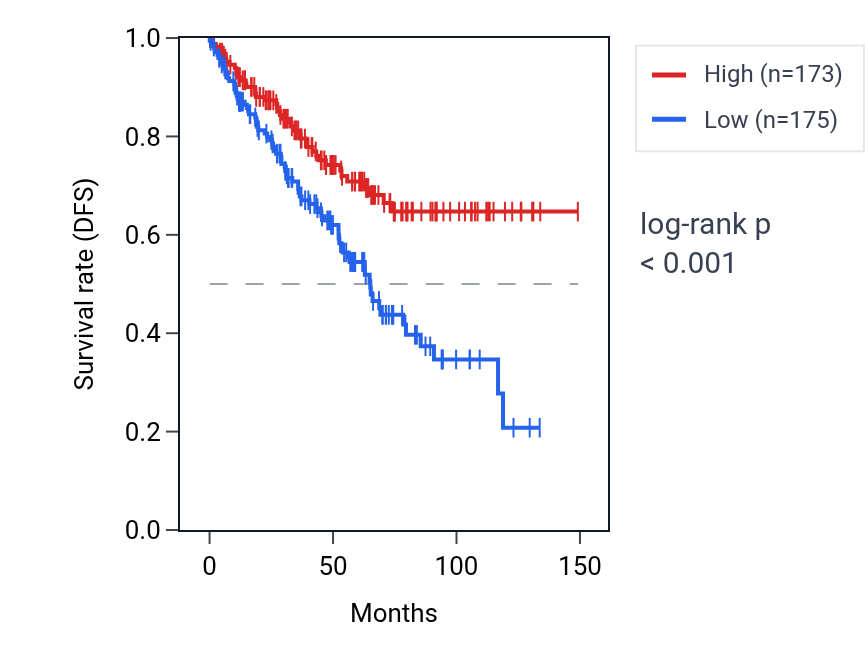
This table ranks reproducible OSBPL8 RNA expression–survival associations across cancer types. High OSBPL8 expression shows unfavorable associations in MESO, BLCA and CESC, but favorable associations in KIRC, BRCA and HNSC. The KIRC Kaplan–Meier curve shows clear separation, with the low-expression group declining faster, consistent with the favorable association (log-rank p < 0.001). Together, the overview and detailed table identify KIRC as the clearest survival context for OSBPL8 RNA expression.
This table summarizes OSBPL8 tumor–normal expression differences by data type. RNA shows broader differences across cancer types, with a lineage consensus of 12, while mass-spec protein shows differences in 9. The strongest signals are observed in HNSC for RNA and COAD for protein.
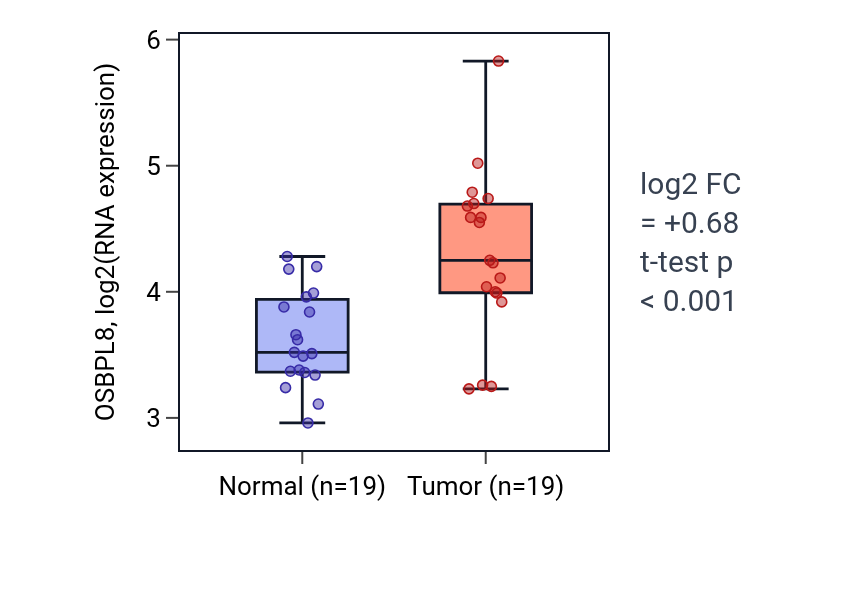
This table ranks reproducible tumor–normal expression differences for OSBPL8. A negative fold-change indicates higher expression in normal tissue than in tumor tissue. OSBPL8 shows lower tumor expression in THCA and KICH and higher tumor expression in COAD, HNSC, CHOL and READ. The COAD box plot shows higher OSBPL8 RNA expression in tumor versus normal tissue (log2 FC = +0.677, t-test p < 0.001).
This table shows molecular features associated with OSBPL8 in patient tissues and cancer cell lines. In patient samples, OSBPL8 shows the broadest associations at the RNA and protein expression levels, with PDAC recurring as the lineage with the largest associated feature set. In cancer cell lines, OSBPL8 RNA and mutation anchors are most strongly linked to RNA-expression features, especially in UPPER_AERODIGESTIVE_TRACT, while CRISPR and shRNA rows add functional-dependency signals in SOFT_TISSUE and BLOOD_Leukemia.