Pigment granule maturation
pathway activity & survivalAcross TCGA pan-cancer cohorts, RNA activity of the Pigment granule maturation pathway is associated with patient survival in 21 of 34 cancer lineages. Pathway activity is summarized from the expression of its 10 member genes.
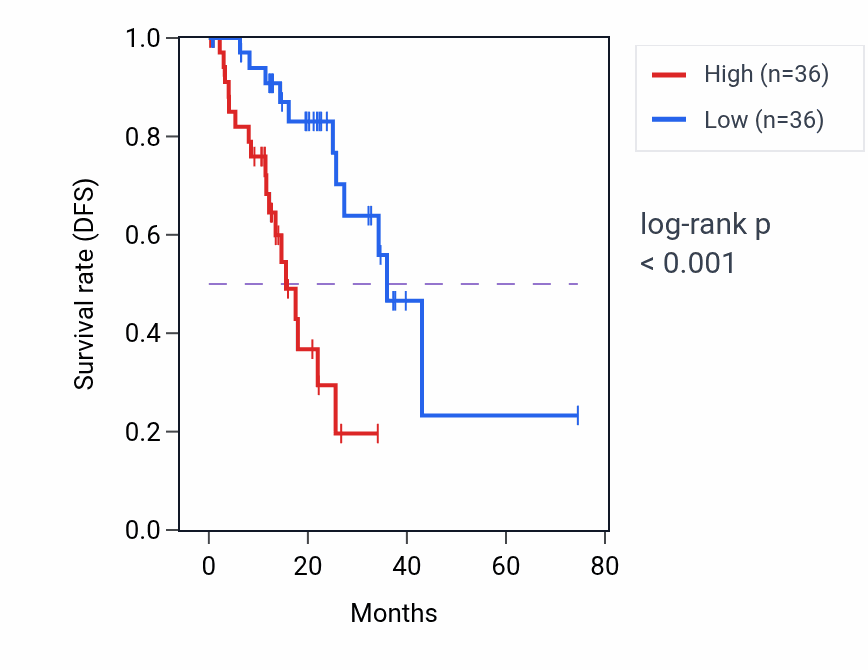
The strongest signal is observed in stomach adenocarcinoma (STAD), where higher Pigment granule maturation pathway activity is associated with poorer disease-free survival. In most high-consensus cancer types, elevated pathway activity shows an unfavorable survival association, although some cancer types, such as HNSC and UCS, show the opposite pattern, with higher activity associated with better survival.
STAD, HNSC, and COAD are the cancer lineages in which this pathway most reproducibly stratifies patient survival.
Pathway-activity survival associations by lineage
Ranked by sampling consensus. AUC1 and AUC2 represent the survival AUCs for the high- and low-pathway-activity groups, respectively. The group with the lower AUC is interpreted as having poorer survival. The reported p-values are derived from the log-rank test.
Pink = unfavorable, green = favorable. Showing the 12 strongest of 21 lineages.
Exploration
- Same pathway, other analysis: tumor-vs-normal Pigment granule maturation activity · full GO:0048757 profile