RPEP4

RNA expression — cross-omics
Cross-omicsRNA → FUNCTION-RNAPatientPairwise association · TCGA cohorts

Across TCGA patient cohorts, RPEP4 RNA expression is significantly associated with the go_rna of many other GO terms, with 6,653 significant associations in total. STAD shows the largest number of these associations.

The most reproducible RPEP4-associated GO terms across cancer lineages are Peptidyl-lysine modification, Regulation of post-translational protein modification, and Positive regulation of double-strand break repair. Each is linked with RPEP4 in more than 18 cancer types. Because this analysis shows association rather than direction, both RPEP4-to-partner and partner-to-RPEP4 results are reported.

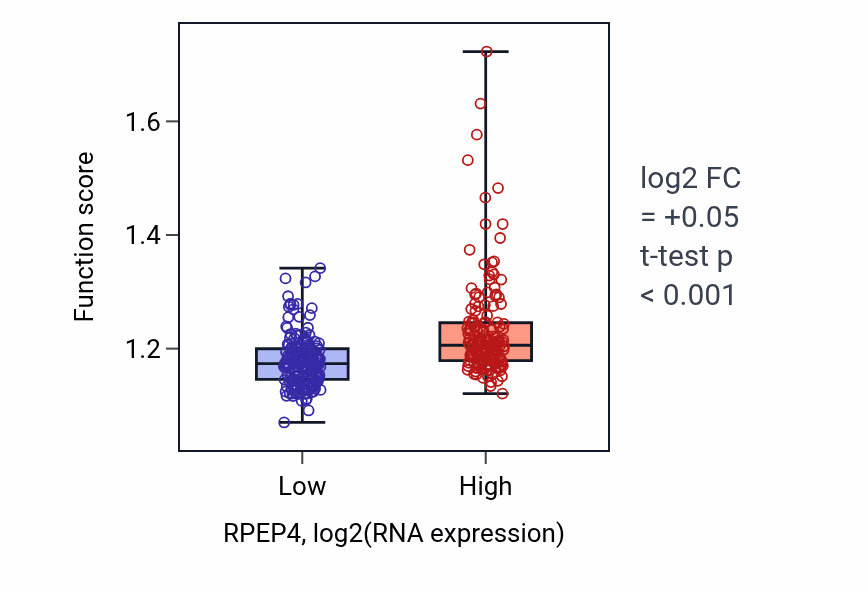
Each partner links to its own Q-omics profile. The box plot shows the strongest example, Peptidyl-lysine modification grouped by RPEP4-low versus RPEP4-high in STAD.
RNA expression associated GO terms by consensus

Ranked by combined sampling and lineage consensus. X-score (RPEP4→partner) and Y-score (partner→RPEP4) are standardized regression coefficients; both directions are reported because the association is undirected. p-values are from the association test.
LineagePartner GO termX-scoreY-scorep(X)p(Y)Sampling consensusLineage consensus
STADPeptidyl-lysine modification →+0.056+0.353<.001<.001319
STADRegulation of post-translational protein modification →+0.060+0.379<.001<.001319
STADPositive regulation of double-strand break repair →+0.053+0.358<.001<.001319
STADDNA modification →+0.050+0.352<.001<.001319
STADNuclear-transcribed mRNA catabolic process, nonsense-mediated decay →+0.067+0.374<.001<.001318
ESCANegative regulation of RNA catabolic process →+0.055+0.469<.001<.001318
Each partner links to its Q-omics profile. Showing the 6 strongest of 6,653 associations by consensus.

Peptidyl-lysine modification by RPEP4 expression — STAD

Box plot of Peptidyl-lysine modification in RPEP4-low vs RPEP4-high samples in STAD.

Explore this box plot interactively →

Exploration