PHYHIPL

RNA expression — cross-omics
Cross-omicsRNA → FUNCTION-RNACell-linePairwise association · TCGA cohorts

Across TCGA cell cohorts, PHYHIPL RNA expression is significantly associated with the go_rna of many other GO terms, with 1,608 significant associations in total. LIVER shows the largest number of these associations.

The most reproducible PHYHIPL-associated GO terms across cancer lineages are Regulation of potassium ion transport, Regulation of corticosterone secretion, and Negative regulation of mRNA catabolic process. Each is linked with PHYHIPL in more than 4 cancer types. Because this analysis shows association rather than direction, both PHYHIPL-to-partner and partner-to-PHYHIPL results are reported.

Each partner links to its own Q-omics profile. The box plot shows the strongest example, Regulation of potassium ion transport grouped by PHYHIPL-low versus PHYHIPL-high in CNS.

RNA expression associated GO terms by consensus

Ranked by combined sampling and lineage consensus. X-score (PHYHIPL→partner) and Y-score (partner→PHYHIPL) are standardized regression coefficients; both directions are reported because the association is undirected. p-values are from the association test.
LineagePartner GO termX-scoreY-scorep(X)p(Y)Sampling consensusLineage consensus
CNSRegulation of potassium ion transport →-0.099-1.201.002.00635
LUNG_SCLCRegulation of corticosterone secretion →-0.741-2.016.008<.00135
LIVERNegative regulation of mRNA catabolic process →+0.059+2.573<.001<.00135
BREASTHost-mediated activation of viral genome replication →+0.061+0.537.002.00834
LUNG_NSCLC_LUADRegulation of Ras protein signal transduction →-0.058-0.453.001.00825
SOFT_TISSUEPyrimidine nucleotide transport →+0.079+0.695.003.00725
Each partner links to its Q-omics profile. Showing the 6 strongest of 1,608 associations by consensus.

Regulation of potassium ion transport by PHYHIPL expression — CNS
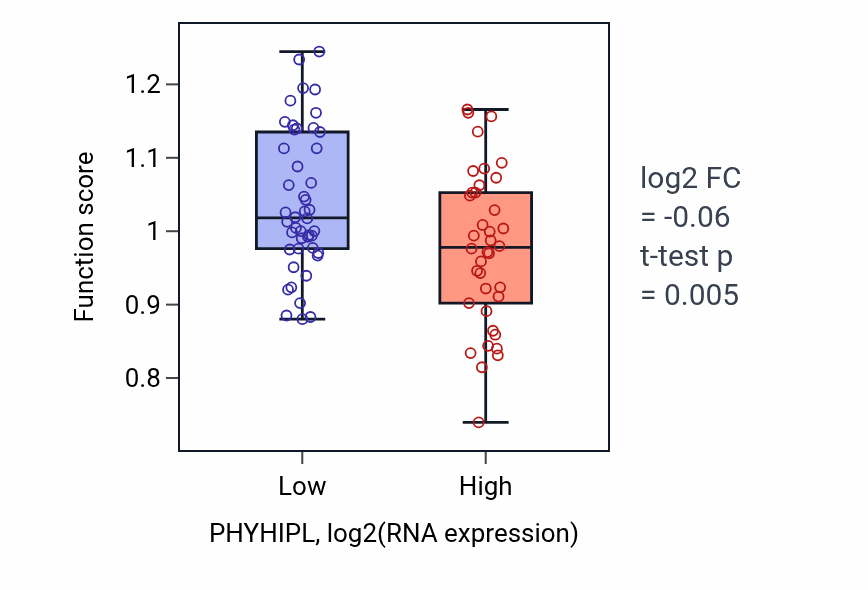
Box plot of Regulation of potassium ion transport in PHYHIPL-low vs PHYHIPL-high samples in CNS.

Explore this box plot interactively →

Exploration