OXT

RNA expression — cross-omics
Cross-omicsRNA → FUNCTION-RNACell-linePairwise association · TCGA cohorts

Across TCGA cell cohorts, OXT RNA expression is significantly associated with the go_rna of many other GO terms, with 206 significant associations in total. LUNG_SCLC shows the largest number of these associations.

The most reproducible OXT-associated GO terms across cancer lineages are Maternal aggressive behavior, L-histidine transmembrane transport, and Establishment or maintenance of microtubule cytoskeleton polarity. Each is linked with OXT in more than 5 cancer types. Because this analysis shows association rather than direction, both OXT-to-partner and partner-to-OXT results are reported.

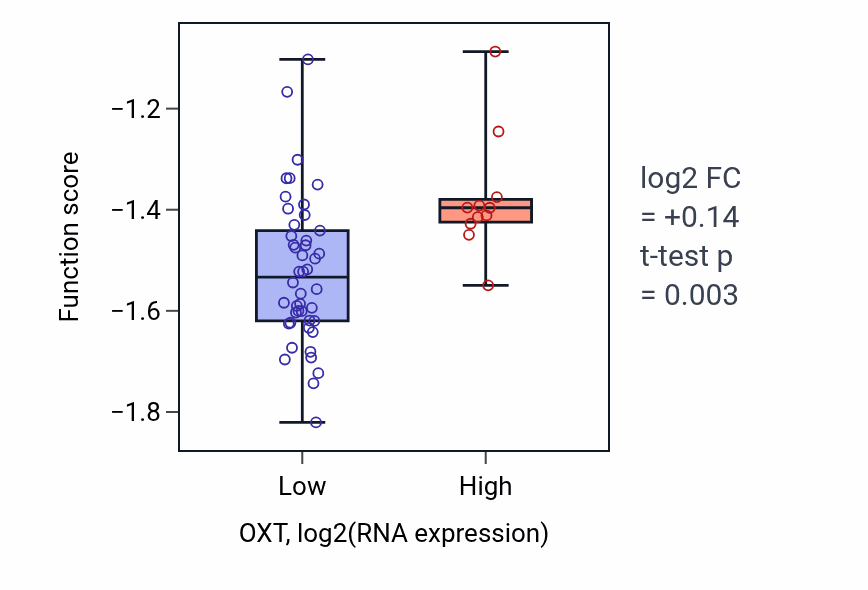
Each partner links to its own Q-omics profile. The box plot shows the strongest example, Maternal aggressive behavior grouped by OXT-low versus OXT-high in BREAST.
RNA expression associated GO terms by consensus

Ranked by combined sampling and lineage consensus. X-score (OXT→partner) and Y-score (partner→OXT) are standardized regression coefficients; both directions are reported because the association is undirected. p-values are from the association test.
LineagePartner GO termX-scoreY-scorep(X)p(Y)Sampling consensusLineage consensus
BREASTMaternal aggressive behavior →+0.145+0.055.003.00636
PANCREASL-histidine transmembrane transport →+0.107+0.071<.001.00624
BLOOD_LeukemiaEstablishment or maintenance of microtubule cytoskeleton polarity →-0.090-0.140.006.00333
BREASTResponse to light stimulus →+0.032+0.097.003.00832
BREASTAldehyde catabolic process →+0.111+0.055.001.00632
SOFT_TISSUERegulation of vesicle transport along microtubule →-0.125-0.042<.001.00432
Each partner links to its Q-omics profile. Showing the 6 strongest of 206 associations by consensus.

Maternal aggressive behavior by OXT expression — BREAST

Box plot of Maternal aggressive behavior in OXT-low vs OXT-high samples in BREAST.

Explore this box plot interactively →

Exploration