GGA1

RNA expression — cross-omics
Cross-omicsRNA → FUNCTION-RNAPatientPairwise association · TCGA cohorts

Across TCGA patient cohorts, GGA1 RNA expression is significantly associated with the go_rna of many other GO terms, with 7,166 significant associations in total. KIRC shows the largest number of these associations.

The most reproducible GGA1-associated GO terms across cancer lineages are Positive regulation of sphingolipid biosynthetic process, Regulation of sphingolipid biosynthetic process, and Base-excision repair, gap-filling. Each is linked with GGA1 in more than 28 cancer types. Because this analysis shows association rather than direction, both GGA1-to-partner and partner-to-GGA1 results are reported.

Each partner links to its own Q-omics profile. The box plot shows the strongest example, Positive regulation of sphingolipid biosynthetic process grouped by GGA1-low versus GGA1-high in LUAD.

RNA expression associated GO terms by consensus

Ranked by combined sampling and lineage consensus. X-score (GGA1→partner) and Y-score (partner→GGA1) are standardized regression coefficients; both directions are reported because the association is undirected. p-values are from the association test.
LineagePartner GO termX-scoreY-scorep(X)p(Y)Sampling consensusLineage consensus
LUADPositive regulation of sphingolipid biosynthetic process →+0.077+0.655<.001<.001329
UVMRegulation of sphingolipid biosynthetic process →+0.068+0.367<.001.009127
KIRCBase-excision repair, gap-filling →+0.048+0.480<.001<.001325
KIRPObsolete regulation of histone methylation →+0.054+0.565<.001<.001325
SCLCObsolete histone modification →+0.096+1.910<.001<.001324
THYMCOPI-coated vesicle budding →+0.070+0.634<.001<.001324
Each partner links to its Q-omics profile. Showing the 6 strongest of 7,166 associations by consensus.

Positive regulation of sphingolipid biosynthetic process by GGA1 expression — LUAD
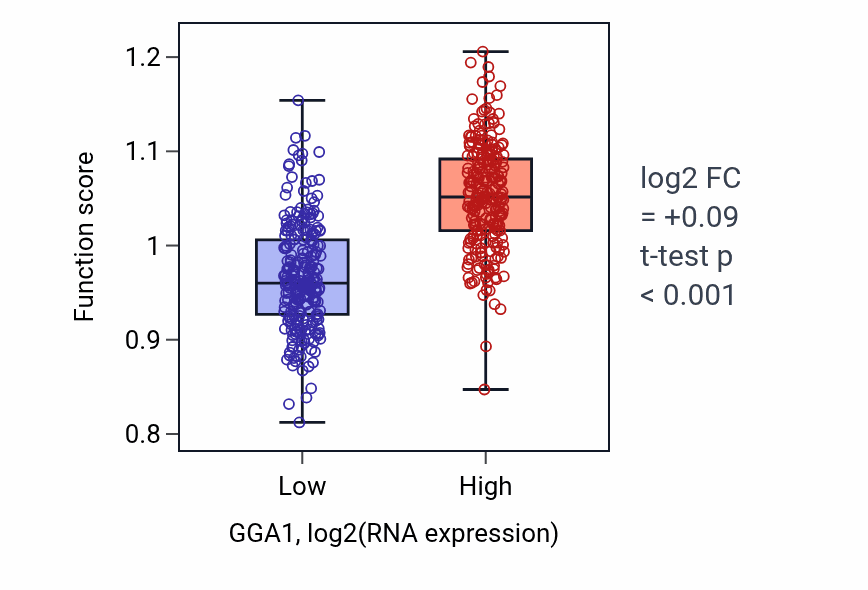
Box plot of Positive regulation of sphingolipid biosynthetic process in GGA1-low vs GGA1-high samples in LUAD.

Explore this box plot interactively →

Exploration