Replication-born double-strand break repair via sister chromatid exchange
pathway activity — cross-omicsAcross TCGA cell cohorts, RNA activity of the Replication-born double-strand break repair via sister chromatid exchange pathway is significantly associated with the RNA expression of multiple genes, with the KIDNEY cohort showing a particularly strong set of associations.
The most reproducible pathway-associated genes across cancer lineages are CEP57L1, RAB23, and TMEM242, each associated with the pathway in up to 5 cancer types. Since the analysis shows associations rather than directional relationships, both pathway-to-partner and partner-to-pathway views are reported.
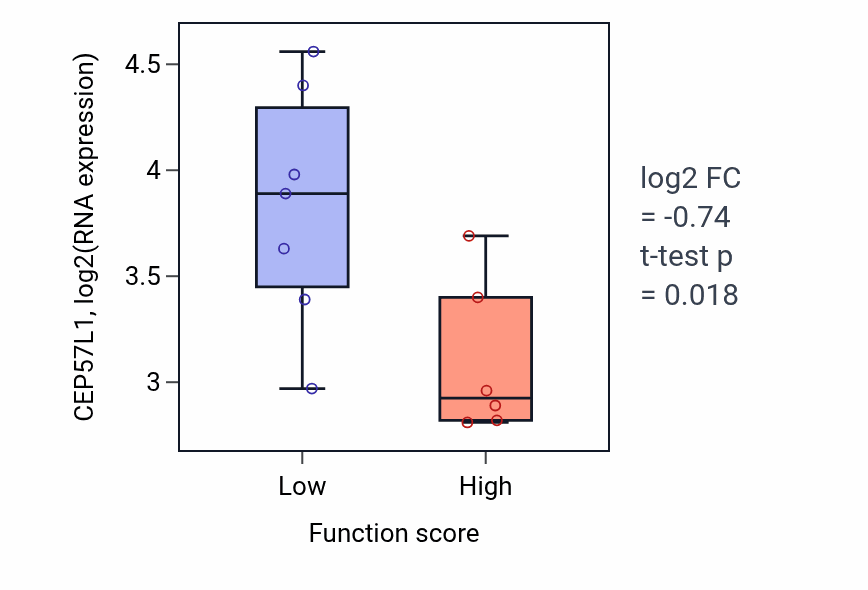
Each partner is linked to its corresponding Q-omics profile. The box plot shows the strongest association, CEP57L1 grouped by Replication-born double-strand break repair via sister chromatid exchange-low versus -high activity in KIDNEY.
Pathway-associated genes by consensus
CEP57L1 by Replication-born double-strand break repair via sister chromatid exchange activity — KIDNEY