Positive regulation of response to endoplasmic reticulum stress

pathway activity — cross-omics
GO:1905898Cross-omicsRNA → PROTEIN-MSPatientPairwise association · TCGA cohorts

Across TCGA patient cohorts, RNA activity of the Positive regulation of response to endoplasmic reticulum stress pathway is significantly associated with the protein abundance of multiple proteins, with the COAD cohort showing a particularly strong set of associations.

The most reproducible pathway-associated proteins across cancer lineages are DPYD, RPS2, and RPL5, each associated with the pathway in up to 7 cancer types. Since the analysis shows associations rather than directional relationships, both pathway-to-partner and partner-to-pathway views are reported.

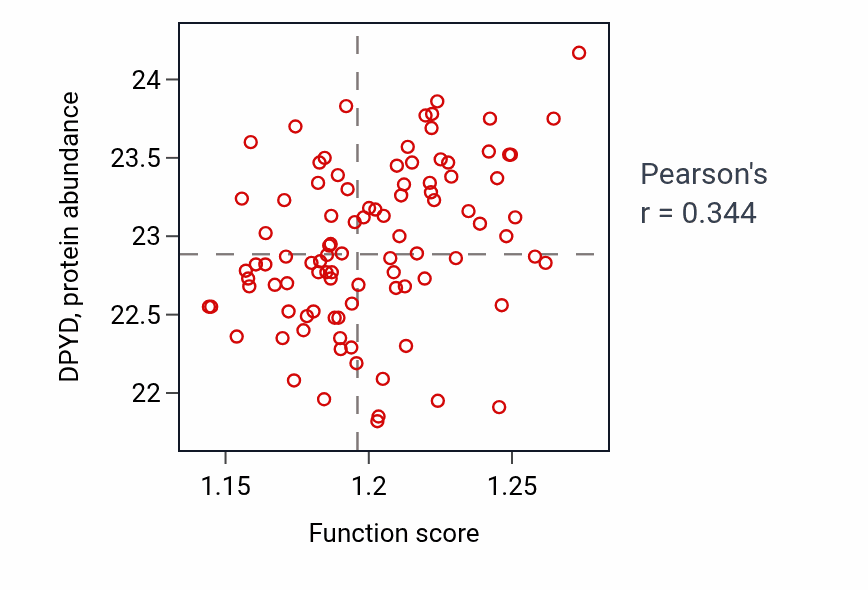
Each partner is linked to its corresponding Q-omics profile. The scatter plot shows the strongest association, Positive regulation of response to endoplasmic reticulum stress activity versus DPYD in COAD (Pearson r = 0.34).
Pathway-associated proteins by consensus

Ranked by combined sampling and lineage consensus. X-score (pathway→partner) and Y-score (partner→pathway) are standardized regression coefficients; both directions are reported because the association is undirected. The reported p-values are derived from the association test.
LineagePartner proteinX-scoreY-scorep(X)p(Y)Sampling consensusLineage consensus
COADDPYD →+0.478+0.024<.001<.00137
COADRPS2 →-0.183-0.027.004<.00137
BRCARPL5 →-0.212-0.044<.001<.00137
BRCARPS8 →-0.320-0.049<.001<.00137
BRCAMMP2 →+0.768+0.035<.001<.00137
BRCARPL3 →-0.343-0.039<.001<.00136
Each partner links to its Q-omics profile. Showing the 6 strongest associations by consensus.

GO:1905898 vs DPYD — COAD

Per-sample scatter of Positive regulation of response to endoplasmic reticulum stress activity vs DPYD in COAD.

Explore this scatter interactively →

Exploration