Regulation of intrinsic apoptotic signaling pathway in response to DNA damage

pathway activity — cross-omics
GO:1902229Cross-omicsPROTEIN-MS → RNACellPairwise association · TCGA cohorts

Across TCGA cell cohorts, RNA activity of the Regulation of intrinsic apoptotic signaling pathway in response to DNA damage pathway is significantly associated with the RNA expression of multiple genes, with the BLOOD_Lymphoma cohort showing a particularly strong set of associations.

The most reproducible pathway-associated genes across cancer lineages are HJURP, EPCAM, and CSGALNACT2, each associated with the pathway in up to 6 cancer types. Since the analysis shows associations rather than directional relationships, both pathway-to-partner and partner-to-pathway views are reported.

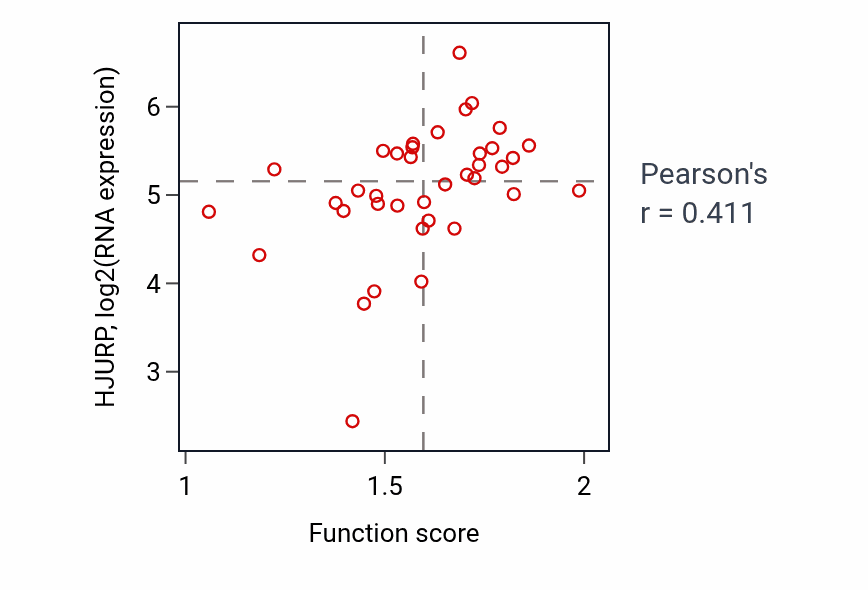
Each partner is linked to its corresponding Q-omics profile. The scatter plot shows the strongest association, Regulation of intrinsic apoptotic signaling pathway in response to DNA damage activity versus HJURP in BLOOD_Lymphoma (Pearson r = 0.41).
Pathway-associated genes by consensus

Ranked by combined sampling and lineage consensus. X-score (pathway→partner) and Y-score (partner→pathway) are standardized regression coefficients; both directions are reported because the association is undirected. The reported p-values are derived from the association test.
LineagePartner geneX-scoreY-scorep(X)p(Y)Sampling consensusLineage consensus
BLOOD_LymphomaHJURP →+0.823+0.214.003<.00136
URINARY_TRACTEPCAM →-5.609-0.364.001.00935
URINARY_TRACTCSGALNACT2 →+1.170+0.373.001.00635
LUNG_SCLCZC3H13 →+0.478+0.205.004.00235
LUNG_SCLCTDRD7 →-1.172-0.235<.001.00435
SOFT_TISSUEDCAF5 →-1.362-0.651.001.00434
Each partner links to its Q-omics profile. Showing the 6 strongest associations by consensus.

GO:1902229 vs HJURP — BLOOD_Lymphoma

Per-sample scatter of Regulation of intrinsic apoptotic signaling pathway in response to DNA damage activity vs HJURP in BLOOD_Lymphoma.

Explore this scatter interactively →

Exploration