Negative regulation of long-term synaptic potentiation

pathway activity — cross-omics
GO:1900272Cross-omicsPROTEIN-MS → RNACellPairwise association · TCGA cohorts

Across TCGA cell cohorts, RNA activity of the Negative regulation of long-term synaptic potentiation pathway is significantly associated with the RNA expression of multiple genes, with the SOFT_TISSUE cohort showing a particularly strong set of associations.

The most reproducible pathway-associated genes across cancer lineages are PRNP, UBQLNL, and KMT5B, each associated with the pathway in up to 4 cancer types. Since the analysis shows associations rather than directional relationships, both pathway-to-partner and partner-to-pathway views are reported.

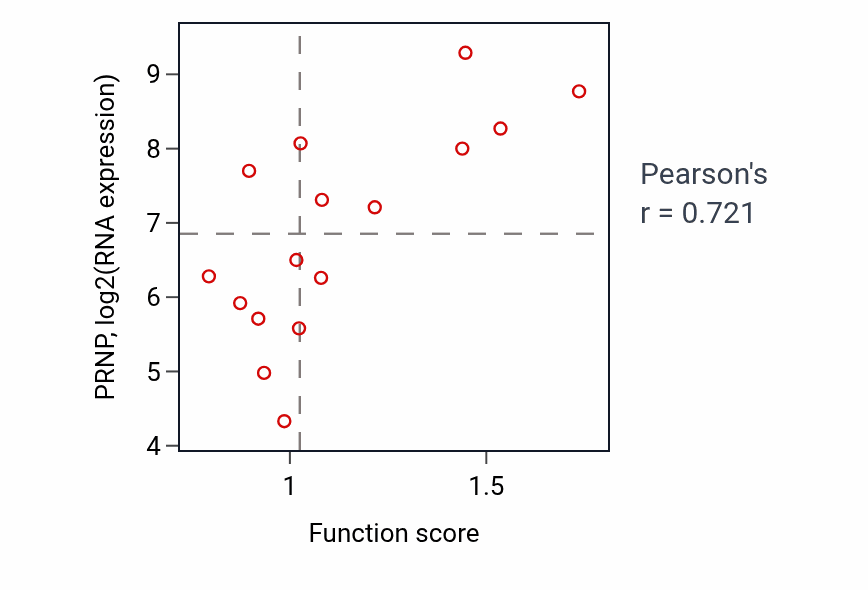
Each partner is linked to its corresponding Q-omics profile. The scatter plot shows the strongest association, Negative regulation of long-term synaptic potentiation activity versus PRNP in SOFT_TISSUE (Pearson r = 0.72).
Pathway-associated genes by consensus

Ranked by combined sampling and lineage consensus. X-score (pathway→partner) and Y-score (partner→pathway) are standardized regression coefficients; both directions are reported because the association is undirected. The reported p-values are derived from the association test.
LineagePartner geneX-scoreY-scorep(X)p(Y)Sampling consensusLineage consensus
SOFT_TISSUEPRNP →+2.022+0.344.001.00634
SOFT_TISSUEUBQLNL →+0.261+0.349<.001.00534
BLOOD_LeukemiaKMT5B →+0.603+0.797<.001.00634
LUNG_NSCLC_LUSCANTKMT →-0.883-0.370<.001<.00134
LUNG_NSCLC_LUSCGOLGA8B →-1.017-0.343.003.00134
BREASTHBEGF →+1.266+0.277.005<.00134
Each partner links to its Q-omics profile. Showing the 6 strongest associations by consensus.

GO:1900272 vs PRNP — SOFT_TISSUE

Per-sample scatter of Negative regulation of long-term synaptic potentiation activity vs PRNP in SOFT_TISSUE.

Explore this scatter interactively →

Exploration