Regulation of dendritic spine morphogenesis

pathway activity — cross-omics
GO:0061001Cross-omicsPROTEIN-MS → RNAPatientPairwise association · TCGA cohorts

Across TCGA patient cohorts, RNA activity of the Regulation of dendritic spine morphogenesis pathway is significantly associated with the RNA expression of multiple genes, with the LUAD cohort showing a particularly strong set of associations.

The most reproducible pathway-associated genes across cancer lineages are MTCYBP43, SLC39A9, and SNHG29, each associated with the pathway in up to 5 cancer types. Since the analysis shows associations rather than directional relationships, both pathway-to-partner and partner-to-pathway views are reported.

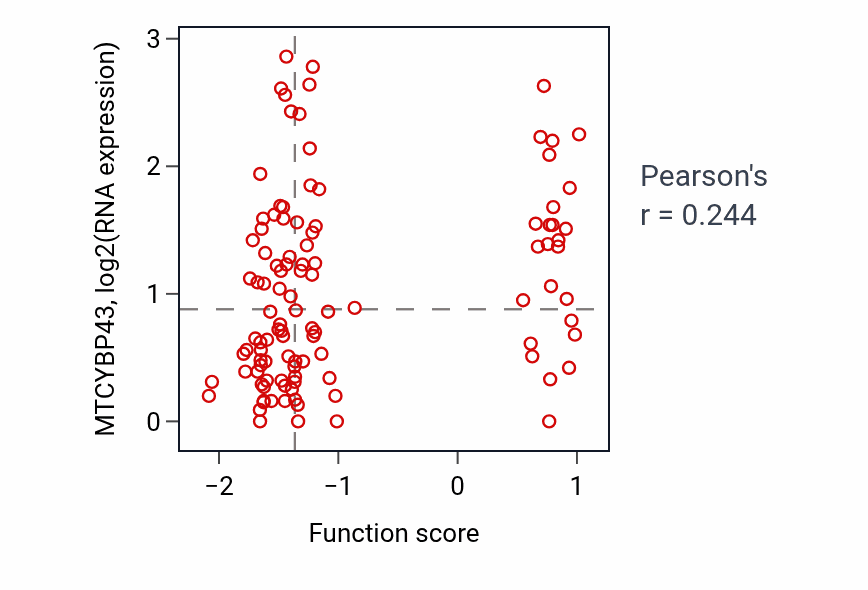
Each partner is linked to its corresponding Q-omics profile. The scatter plot shows the strongest association, Regulation of dendritic spine morphogenesis activity versus MTCYBP43 in LUAD (Pearson r = 0.24).
Pathway-associated genes by consensus

Ranked by combined sampling and lineage consensus. X-score (pathway→partner) and Y-score (partner→pathway) are standardized regression coefficients; both directions are reported because the association is undirected. The reported p-values are derived from the association test.
LineagePartner geneX-scoreY-scorep(X)p(Y)Sampling consensusLineage consensus
LUADMTCYBP43 →+0.468+0.722.003<.00135
LUADSLC39A9 →+0.471+0.866<.001<.00135
LSCCSNHG29 →-0.672-0.664.002.00234
BRCAHNRNPA1P10 →-0.855-0.346.001.00434
PDACSEMA7A →+0.591+0.216.003.00434
OVSIPA1L1 →+0.689+0.354.008.00134
Each partner links to its Q-omics profile. Showing the 6 strongest associations by consensus.

GO:0061001 vs MTCYBP43 — LUAD

Per-sample scatter of Regulation of dendritic spine morphogenesis activity vs MTCYBP43 in LUAD.

Explore this scatter interactively →

Exploration