Paranodal junction assembly

pathway activity & survival
GO:0030913SurvivalRNA activityKaplan–Meier · TCGA cohorts

Across TCGA pan-cancer cohorts, RNA activity of the Paranodal junction assembly pathway is associated with patient survival in 21 of 34 cancer lineages. Pathway activity is summarized from the expression of its 6 member genes.

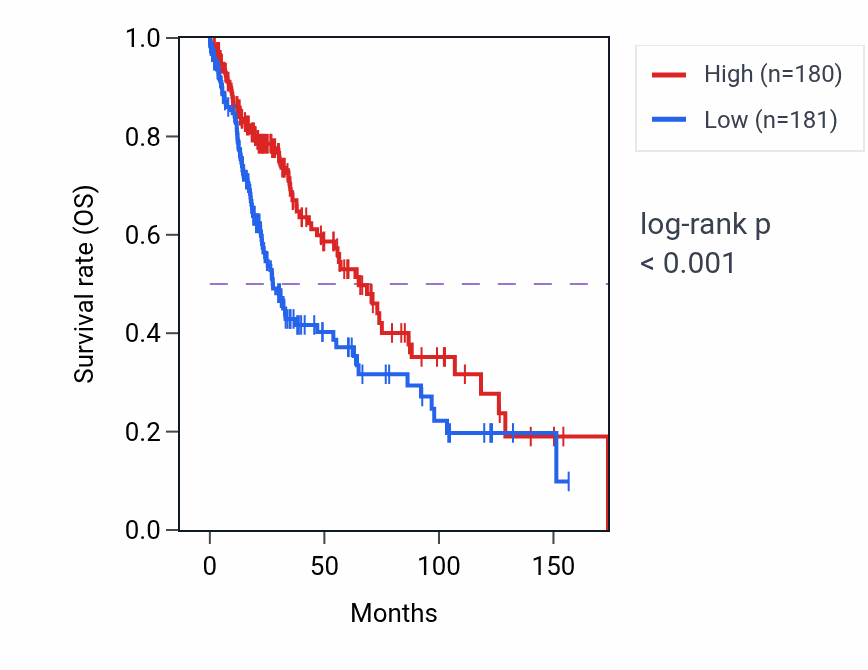
The strongest signal is observed in lung squamous cell carcinoma (LUSC), where higher Paranodal junction assembly pathway activity is associated with better overall survival. In most high-consensus cancer types, elevated pathway activity shows an unfavorable survival association, although some cancer types, such as LUSC and LUAD, show the opposite pattern, with higher activity associated with better survival.

LUSC, LUAD, and BLCA are the cancer lineages in which this pathway most reproducibly stratifies patient survival.

Pathway-activity survival associations by lineage
Ranked by sampling consensus. AUC1 and AUC2 represent the survival AUCs for the high- and low-pathway-activity groups, respectively. The group with the lower AUC is interpreted as having poorer survival. The reported p-values are derived from the log-rank test.
LineageMeasureSplitStageAUC1
high
AUC2
low
pSampling consensus
LUSCOSMedianAll0.7350.584<.00152view →
LUADDFSTertileII,III,IV0.8560.652.00450view →
BLCAOSQuartileII,III,IV0.7130.551.00638view →
PAADDFSQuartileAll0.5680.266.00134view →
SARCOSTertileAll0.8380.551<.00124view →
CESCDFSMedianAll0.7760.862.03410view →
READDFSMedianAll0.6360.434.01010view →
KIRCDFSMedianAll0.8420.908.0199view →
SKCMDFSMedianIV0.0620.641.0039view →
THCAOSTertileIV0.5200.784.0147view →
UCSDFSTertileIII,IV0.4710.145.0216view →
STADDFSQuartileII,III,IV0.5520.815.0426view →
Pink = unfavorable, green = favorable. Showing the 12 strongest of 21 lineages.

GO:0030913–LUSC (OS)

Kaplan–Meier survival curve for Paranodal junction assembly pathway activity in LUSC.

Open the LUSC breakdown →

Exploration