Myoblast fusion involved in skeletal muscle regeneration

pathway activity — cross-omics
GO:0014905Cross-omicsPROTEIN-MS → RNAPatientPairwise association · TCGA cohorts

Across TCGA patient cohorts, RNA activity of the Myoblast fusion involved in skeletal muscle regeneration pathway is significantly associated with the RNA expression of multiple genes, with the CCRCC cohort showing a particularly strong set of associations.

The most reproducible pathway-associated genes across cancer lineages are PTGFRN, FAM162A, and PLPPR4, each associated with the pathway in up to 7 cancer types. Since the analysis shows associations rather than directional relationships, both pathway-to-partner and partner-to-pathway views are reported.

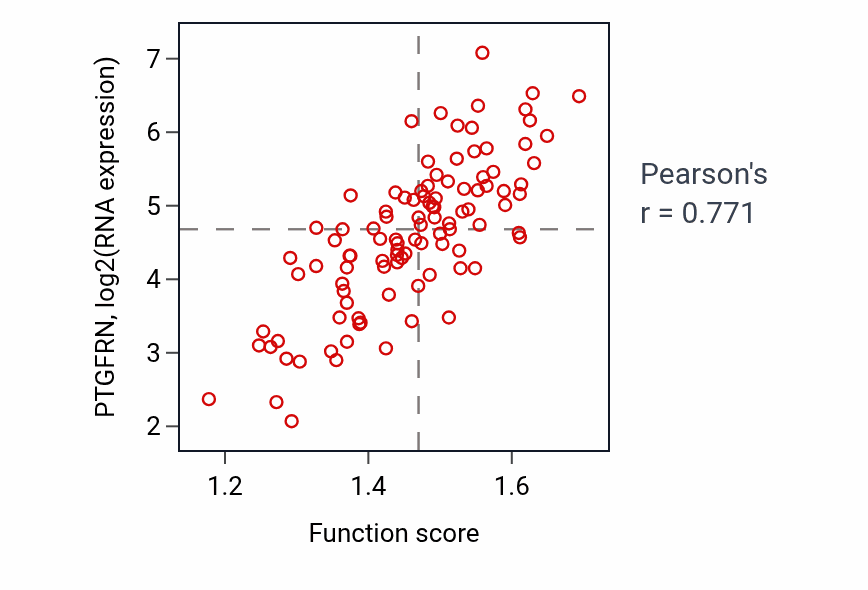
Each partner is linked to its corresponding Q-omics profile. The scatter plot shows the strongest association, Myoblast fusion involved in skeletal muscle regeneration activity versus PTGFRN in CCRCC (Pearson r = 0.77).
Pathway-associated genes by consensus

Ranked by combined sampling and lineage consensus. X-score (pathway→partner) and Y-score (partner→pathway) are standardized regression coefficients; both directions are reported because the association is undirected. The reported p-values are derived from the association test.
LineagePartner geneX-scoreY-scorep(X)p(Y)Sampling consensusLineage consensus
CCRCCPTGFRN →+1.259+0.129<.001<.00137
LSCCFAM162A →+0.685+0.081<.001.00335
OVPLPPR4 →+0.830+0.071<.001.00435
GBMDCLK1 →+0.900+0.049.001<.00135
COADZNF436 →+0.467+0.053.001.00835
PDACCSDC2 →+0.555+0.132.001<.00135
Each partner links to its Q-omics profile. Showing the 6 strongest associations by consensus.

GO:0014905 vs PTGFRN — CCRCC

Per-sample scatter of Myoblast fusion involved in skeletal muscle regeneration activity vs PTGFRN in CCRCC.

Explore this scatter interactively →

Exploration