ZP3P1

RNA expression — cross-omics
Cross-omicsRNA → FUNCTION-RNAPatientPairwise association · TCGA cohorts

Across TCGA patient cohorts, ZP3P1 RNA expression is significantly associated with the go_rna of many other GO terms, with 5,903 significant associations in total. STAD shows the largest number of these associations.

The most reproducible ZP3P1-associated GO terms across cancer lineages are Regulation of calcium ion export across plasma membrane, Biological process involved in interaction with symbiont, and Cellular response to starvation. Each is linked with ZP3P1 in more than 9 cancer types. Because this analysis shows association rather than direction, both ZP3P1-to-partner and partner-to-ZP3P1 results are reported.

Each partner links to its own Q-omics profile. The box plot shows the strongest example, Regulation of calcium ion export across plasma membrane grouped by ZP3P1-low versus ZP3P1-high in STAD.

RNA expression associated GO terms by consensus

Ranked by combined sampling and lineage consensus. X-score (ZP3P1→partner) and Y-score (partner→ZP3P1) are standardized regression coefficients; both directions are reported because the association is undirected. p-values are from the association test.
LineagePartner GO termX-scoreY-scorep(X)p(Y)Sampling consensusLineage consensus
STADRegulation of calcium ion export across plasma membrane →+0.083+0.053<.001<.00139
STADBiological process involved in interaction with symbiont →+0.100+0.050<.001<.00139
STADCellular response to starvation →+0.101+0.050<.001<.00139
STADTelencephalon development →+0.074+0.058<.001<.00139
STADModulation by host of viral process →+0.111+0.056<.001<.00139
STADRegulation of binding →+0.107+0.052<.001<.00138
Each partner links to its Q-omics profile. Showing the 6 strongest of 5,903 associations by consensus.

Regulation of calcium ion export across plasma membrane by ZP3P1 expression — STAD
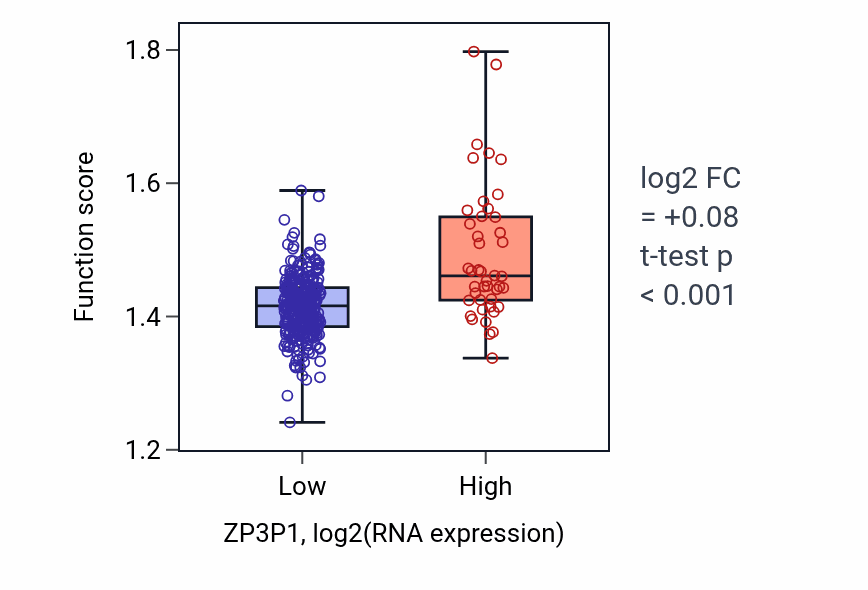
Box plot of Regulation of calcium ion export across plasma membrane in ZP3P1-low vs ZP3P1-high samples in STAD.

Explore this box plot interactively →

Exploration