RUFY3

RNA expression — cross-omics
Cross-omicsRNA → FUNCTION-RNACell-linePairwise association · TCGA cohorts

Across TCGA cell cohorts, RUFY3 RNA expression is significantly associated with the go_rna of many other GO terms, with 5,041 significant associations in total. BLOOD_Leukemia shows the largest number of these associations.

The most reproducible RUFY3-associated GO terms across cancer lineages are Protein modification by small protein removal, Cilium-dependent cell motility, and Cilium movement involved in cell motility. Each is linked with RUFY3 in more than 15 cancer types. Because this analysis shows association rather than direction, both RUFY3-to-partner and partner-to-RUFY3 results are reported.

Each partner links to its own Q-omics profile. The box plot shows the strongest example, Protein modification by small protein removal grouped by RUFY3-low versus RUFY3-high in LARGE_INTESTINE.

RNA expression associated GO terms by consensus

Ranked by combined sampling and lineage consensus. X-score (RUFY3→partner) and Y-score (partner→RUFY3) are standardized regression coefficients; both directions are reported because the association is undirected. p-values are from the association test.
LineagePartner GO termX-scoreY-scorep(X)p(Y)Sampling consensusLineage consensus
LARGE_INTESTINEProtein modification by small protein removal →+0.049+1.176<.001<.001316
OESOPHAGUSCilium-dependent cell motility →-0.089-1.011.002<.001314
URINARY_TRACTCilium movement involved in cell motility →-0.102-1.121.002.001314
OESOPHAGUSSperm motility →-0.134-1.242<.001<.001314
OESOPHAGUSCilium or flagellum-dependent cell motility →-0.089-1.011.002<.001314
LUNG_SCLCViral transcription →+0.131+1.493.001<.001314
Each partner links to its Q-omics profile. Showing the 6 strongest of 5,041 associations by consensus.

Protein modification by small protein removal by RUFY3 expression — LARGE_INTESTINE
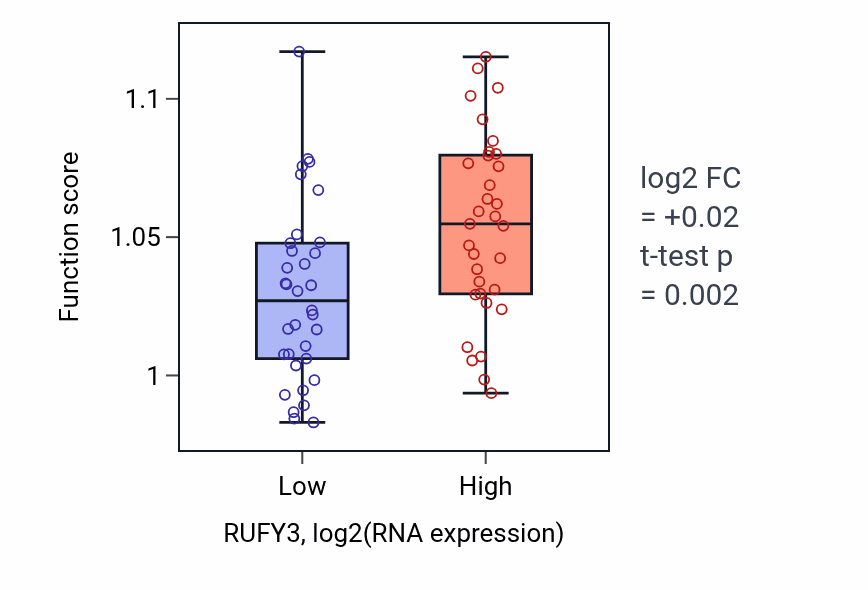
Box plot of Protein modification by small protein removal in RUFY3-low vs RUFY3-high samples in LARGE_INTESTINE.

Explore this box plot interactively →

Exploration