PAIP2

RNA expression — cross-omics
Cross-omicsRNA → FUNCTION-RNACell-linePairwise association · TCGA cohorts

Across TCGA cell cohorts, PAIP2 RNA expression is significantly associated with the go_rna of many other GO terms, with 4,272 significant associations in total. BLOOD_Leukemia shows the largest number of these associations.

The most reproducible PAIP2-associated GO terms across cancer lineages are Protein localization to cilium, DNA replication-dependent chromatin disassembly, and Nucleotide-excision repair. Each is linked with PAIP2 in more than 10 cancer types. Because this analysis shows association rather than direction, both PAIP2-to-partner and partner-to-PAIP2 results are reported.

Each partner links to its own Q-omics profile. The box plot shows the strongest example, Protein localization to cilium grouped by PAIP2-low versus PAIP2-high in URINARY_TRACT.

RNA expression associated GO terms by consensus

Ranked by combined sampling and lineage consensus. X-score (PAIP2→partner) and Y-score (partner→PAIP2) are standardized regression coefficients; both directions are reported because the association is undirected. p-values are from the association test.
LineagePartner GO termX-scoreY-scorep(X)p(Y)Sampling consensusLineage consensus
URINARY_TRACTProtein localization to cilium →+0.061+0.644<.001.004311
BREASTDNA replication-dependent chromatin disassembly →+0.087+0.714.001<.001311
UPPER_AERODIGESTIVE_TRACTNucleotide-excision repair →+0.068+0.705.001.002311
BLOOD_MyelomaRegulation of centriole elongation →+0.086+0.656.003.002310
BLOOD_MyelomaProtein localization to nucleus →+0.062+0.686<.001.003310
URINARY_TRACTChromosomal DNA methylation maintenance following DNA replication →+0.180+0.764.007.001310
Each partner links to its Q-omics profile. Showing the 6 strongest of 4,272 associations by consensus.

Protein localization to cilium by PAIP2 expression — URINARY_TRACT
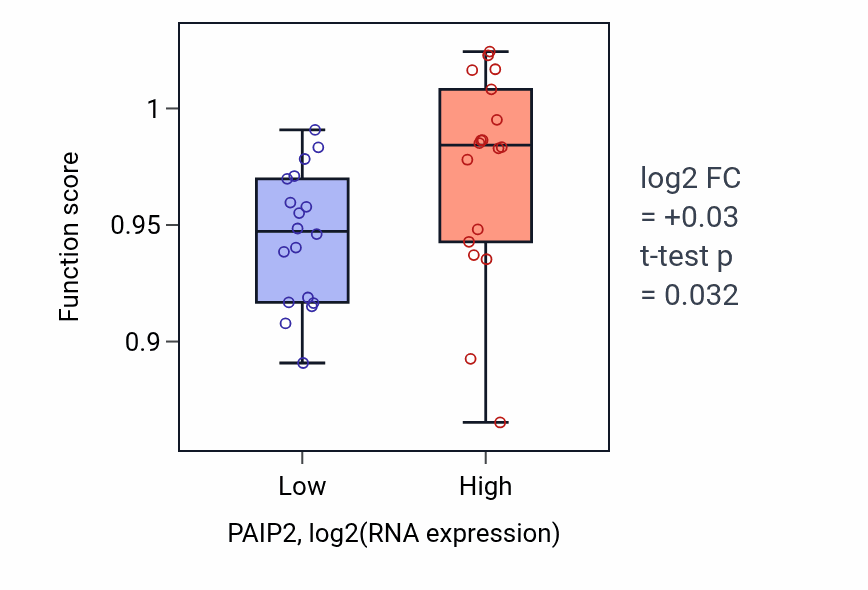
Box plot of Protein localization to cilium in PAIP2-low vs PAIP2-high samples in URINARY_TRACT.

Explore this box plot interactively →

Exploration