SB590885

response biomarkers — cross-omics
Drug responseDRUG → FUNCTION-SHRNACell lineSB-590885

Across CCLE and GDSC cell-line panels, response to SB590885 is significantly associated with the shRNA pathway dependency of multiple pathways, with LARGE_INTESTINE cell lines showing a particularly strong set of associations.

The most reproducible SB590885 response-associated pathways across cancer lineages are Heat acclimation, Cellular heat acclimation, and MHC class I protein complex assembly, each associated with drug response in up to 8 lineages. Since the analysis identifies associations rather than directional relationships, both response-to-biomarker and biomarker-to-response views are provided.

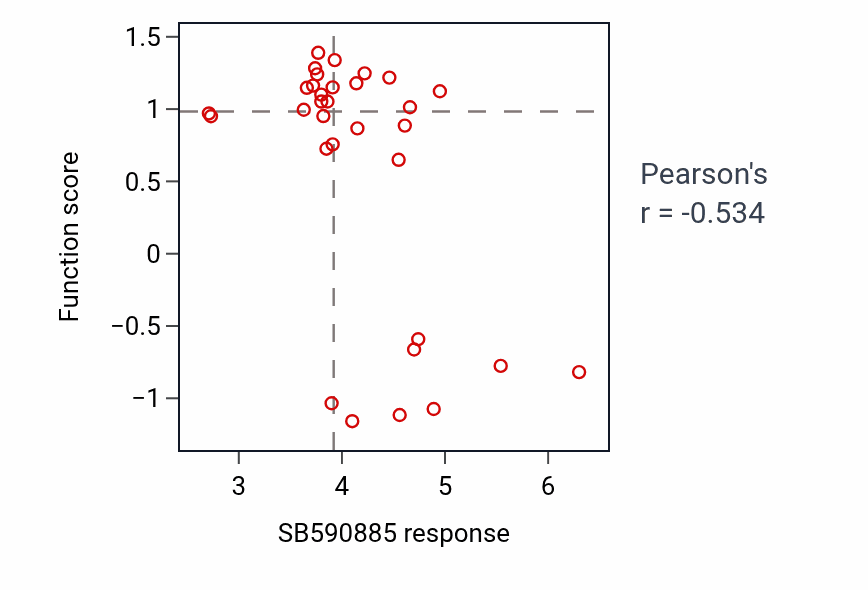
Each biomarker is linked to its corresponding Q-omics profile. The scatter plot shows the strongest observed association, SB590885 response versus Heat acclimation shRNA pathway dependency in LARGE_INTESTINE (Pearson r = -0.53).

Shrna pathway dependency biomarkers of SB590885 response
Ranked by combined sampling and lineage consensus. X-score (response→biomarker) and Y-score (biomarker→response) are standardized regression coefficients; both directions are reported because the association is undirected. The reported p-values are derived from the association test.
LineagePartner pathwayX-scoreY-scorep(X)p(Y)Sampling consensusLineage consensus
LARGE_INTESTINEHeat acclimation →-1.254-0.873.002.00937
LARGE_INTESTINECellular heat acclimation →-1.254-0.873.002.00937
STOMACHMHC class I protein complex assembly →-1.210-0.471.009.01237
STOMACHPeptide antigen assembly with MHC class I protein complex →-1.210-0.471.009.01237
BLOOD_LeukemiaRegulation of cold-induced thermogenesis →+0.171+0.400.039.01537
PANCREASRegulation of type I interferon-mediated signaling pathway →-0.705-0.554.020.00436
Each biomarker links to its Q-omics profile. Showing the 6 strongest associations by consensus.

SB590885 response vs Heat acclimation — LARGE_INTESTINE

Per-cell-line scatter of SB590885 response vs Heat acclimation shRNA pathway dependency in LARGE_INTESTINE.

Explore this scatter interactively →

Exploration